
5 October 2026
Carrying all the heavy grocery bags in one go because making a second trip simply isn’t an option. Walking up several flights of stairs without wondering when they became so many. Or simply lifting a heavy suitcase without your lower back reminding you about it the next day.
All of this requires strength, balance, coordination, and stability – qualities we use constantly, even when we don’t realize it.
And that’s exactly where functional training comes in.
The name may sound a little complicated, but the idea behind it is quite practical.
Functional training includes exercises and movements that develop qualities useful both in sports and in everyday life. Instead of looking at the body simply as a collection of separate muscles, many of the exercises involve multiple muscle groups and joints working at the same time.
Squatting, bending, pushing, pulling, carrying, rotating – these are movements we encounter in different forms every day.
Of course, that doesn’t mean every squat automatically becomes “functional.” The exercises should be selected according to the individual, their goals, and their fitness level.
Imagine picking up a box from the floor. Lifting a heavy suitcase into the trunk of a car. Carrying your groceries. Getting up from a low chair. Trying to keep your balance on an icy pavement.
The body rarely uses just one muscle to handle tasks like these. It coordinates multiple muscle groups at the same time, and this ability can be developed through a well-structured functional workout.
So the goal isn’t simply to become stronger at a particular exercise, but to develop strength, control, and confidence in every movement.
One of its biggest advantages is how varied it can be. Depending on the exercises and intensity, each workout can place the focus on different areas.
Strength
Squats, lunges, pulling, pushing, and carrying weights can engage multiple muscle groups at the same time.
Balance and stability
During many movements, the body needs not only to generate strength but also to maintain good positioning and control.
Coordination
When your arms, legs, and torso need to work together, you develop your ability to control more complex movements.
Endurance
When exercises are performed one after another at an appropriate intensity, functional training can also provide a serious challenge for the cardiovascular system.
Mobility
Exercises performed with good control and an appropriate range of motion can also be part of improving mobility.
And the good thing is that no two functional workouts necessarily have to look the same.
One of the best things about functional training is that you never know exactly what to expect.
Today it might be squats, dumbbells, and resistance bands. Next time, it could be a sled, bodyweight exercises, and a completely different challenge. Workouts can easily be varied, making it much harder to get bored with your routine.
If your first association with functional training is someone pushing a huge sled across the gym while everyone else cheers them on – don’t worry. You definitely don’t have to start there.
One of the biggest advantages of this type of training is that movements can be adapted.
A squat, for example, can start with just your bodyweight. Then you can add a dumbbell or another type of weight and gradually increase the load.
The same principle applies to many other exercises.
That’s why functional training can be suitable both for more experienced gym-goers and for beginners. What matters is that the load and complexity of the exercises match your current abilities.
There’s really no reason to give ourselves an ultimatum and choose one or the other.
Traditional strength training is an excellent way to develop strength and muscle mass. Functional exercises can add more work on coordination, stability, and movements we use in everyday life.
The two can easily be part of the same training program.
One day, you might have a more traditional strength workout, while on another you can include more functional exercises. Or you can simply combine elements of both within a single gym session.
After everything you’ve just read about functional training, it’s time for some news from us.
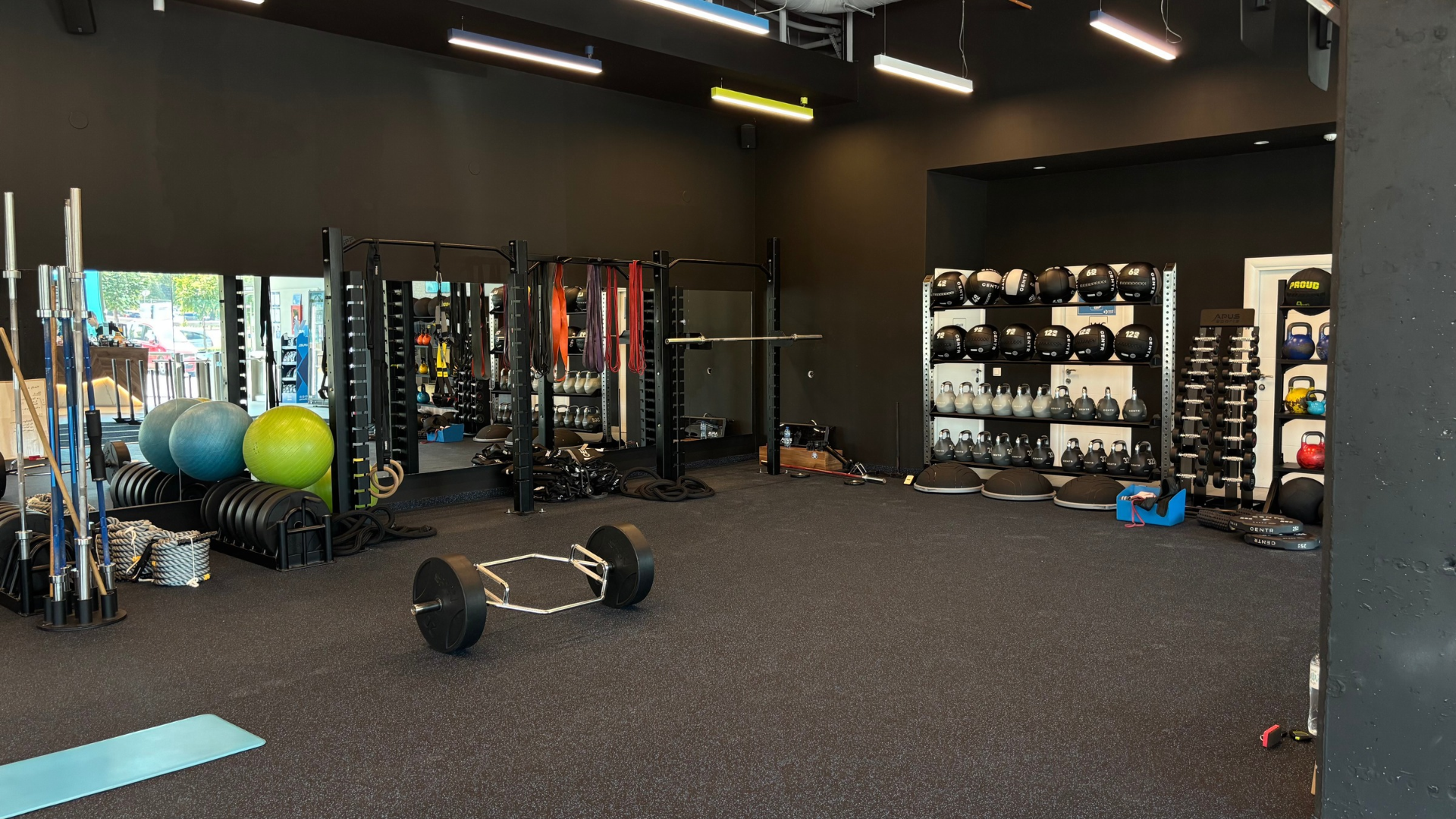
We’ve renovated the functional training zone at Next Level The Mall to give you more space and even more opportunities to add variety to your workouts.
The zone now features new flooring, more open space, and additional equipment that you can use depending on how you prefer to train.
On your own, with a personal trainer, or as part of a group workout – the choice is yours.
And if functional training has always been that part of the gym you walk past while thinking, “I should try that someday,” the renovated zone might just be the perfect reason for that day to finally come.
Because strength isn’t only about how many kilograms you can lift.
It’s also about how well you can use your body in everyday life.